
What transforms a simple garment into an iconic wardrobe staple? The Mica Dress achieves this status through a masterful blend of architectural design and emotional resonance. Its defining reverse halter neckline and fluid metallic jersey create a silhouette that commands space with quiet authority. This analysis deconstructs the elements—from its precise 63.5-inch length to its versatile fabrications—that make it a benchmark for modern elegance, exploring why this particular dress matters in 2025.
The Anatomy of an Icon

Beyond the Seams: Deconstructing the Silhouette
The Architectural Shoulder
The shoulder is where the argument begins. It is a proposition, a line drawn not in sand but in metallic jersey. The reverse halter strap does not merely exist; it performs a function of structural tension, a precise counterbalance that recalls the clean, declarative statements of the DELFI Collective. This is engineering, not ornamentation. Beneath this statement lies a strapless foundation, a silent pact sealed with a hidden back zip closure. The commitment is to form. The single, relentless measurement of 63.5 inches from shoulder to hem is the final clause in this proposition. It is a measurement for a specific kind of woman, one who understands that proportion is its own kind of drama, a verticality that commands space without raising its voice.
The Fabric as Character
To speak of the silhouette is to speak of the substance that gives it breath. The fabric is the protagonist here, the central consciousness. The primary iteration possesses a metallic jersey finish with a midweight drape, a composition of 68% rayon, 28% nylon, and 4% spandex that moves with a knowing, liquid gravity. It catches the light not to shout, but to suggest. There are other voices in this narrative: the crinkled cotton poplin, textural and resolved, with the full lining of a Rails design ensuring a private interior world. Or the contrast, a fabrication of 60% polyester, 35% nylon, and 5% spandex, offering a different tension, a cooler touch. Each variation is a different mood, a different turn in the same story.
The Philosophy of Dressing
When Clothes Become Narrative
The choices embedded in a garment are the chapters of its philosophy. The price point of $298 is one such choice. It is a calculated distance from the fast fashion pieces that clutter the landscape at under $40. This is not a purchase; it is an investment in a specific continuity, a belief in a narrative that extends beyond a single season. Its origin story is written in Los Angeles, not in the anonymous output of imported production. This geography matters. It implies a hand, a oversight, a chain of custody over an idea. And finally, the care instructions—dry clean only—are not a burden but a covenant. They stand in stark opposition to the transient, hand wash cold ephemera of a disposable wardrobe. They demand a certain respect, promising in return a kind of permanence. This is the entirety of the proposition: an object, yes, but also a set of principles.
The specific alchemy of the mica dress is now available for your own narrative through MICAS. Discover it at MICAS
The Many Lives of a Single Dress
The Wedding Guest Uniform
Why It Works When It Matters Most
The calculus is simple. One must appear both committed to the occasion and indifferent to its potential for social judgment. The dress understands this. It becomes a uniform for such negotiations. The testimony, “Wore to a wedding — highly recommend,” is not merely a review; it is a fragment of a solved equation. The metallic pink, in this context, does not glare. It absorbs and returns the light of a late afternoon ceremony or a dimly lit reception hall with a soft, corroborative glow. It signifies without declaring. The formal length, that consistent 63.5 inches, is its own form of diplomacy. It meets the unspoken protocols of a cathedral or a country club with the same vertical assurance, eliminating the variable of inappropriate exposure. It is armor, beautifully disguised.
The Alternative Occasion Calculus
Its utility extends beyond the nuptial frame. The dress possesses a chameleonic logic. For the black-tie-optional event that decays into a cocktail hour, it requires only a change of accessories, a shift in posture. It travels well, this dress, its fabric resisting the deep creases of doubt. In the context of vacation dressing, it offers an elevated sensibility against a foreign landscape, a piece that feels both of the moment and detached from the daily grind. It is, ultimately, a instrument for a series of special events, its versatility spanning the humid air of a summer garden party to the controlled climate of a winter gallery opening. It is one dress that answers many questions.
The Everyday Transcendent
Luxury as Daily Practice
The proposition of the dress is not confined to the exceptional. It is also found in the decision to incorporate its line and sentiment into the mundane. This is where the idea fragments and democratizes. One may engage with the silhouette through Christy Dawn’s Summer Orchard iteration, priced at $268, its crinkled cotton poplin speaking of a softer, more pastoral luxury. Or through Rails’ Blue Marguerite, which offers a version of casual elegance, a garment for a lunch that holds the potential for something more. And for those who seek the form without the foundational philosophy, there is the interpretation by MICAS, a fast fashion rendering available for under $40. It is the same profile, a shadow of the original argument, accessible for a different kind of daily practice.
The specific alchemy of the mica dress, in all its iterations, is now available for your own narrative through MICAS.
Discover it at MICAS
The Material Consequences

The Sustainability Paradox
Price Points and Production Ethics
The dress, in its various forms, carries with it the weight of its own creation. To choose one version over another is to cast a vote for a particular world. There is the Delfi Collective, with its manufacturing anchored in Los Angeles, a fact that speaks not of marketing but of geography and labor, a tangible thread connecting the garment to a specific place and its attendant costs. Its price is a function of this reality. Then there is the proposition of Christy Dawn, whose farm-to-closet philosophy weaves a narrative of rebirth, of cotton grown in revitalized soil, a garment that purports to heal not just the wearer but the land itself. It is a different kind of arithmetic, where the cost is tied to a story of regeneration.
And then there is the other reality, the one of fast fashion, where the same silhouette is rendered for under $40. This version presents its own stark equation: accessibility weighed against the specter of environmental impact. It is the same dress, yet it is not. The form is replicated, but the foundational philosophy is absent, leaving behind only the shape of the idea, stripped of its original context. One must decide what is being purchased: merely an object, or the principles of its making.
| Brand | Philosophy | Approx. Price (2025) |
|---|---|---|
| Delfi Collective | Los Angeles manufacturing | $400+ |
| Christy Dawn | Farm-to-closet, deadstock fabrics | $268 |
| Rails | Casual elegance, core styles | $248 |
| MICAS | Accessible trend replication | <$40 |
The Care and Keeping of Investment Pieces
The longevity of the dress is a deliberate act, a series of small choices that either honor or squander its initial promise. The metallic finish of the original is a delicate veneer, its sheen protected by the stark instruction: dry clean only. This is the maintenance of a relic, a ritual to preserve a specific kind of light. For the crinkled cotton poplin variations, the directive is different: hand wash cold. This is a more intimate form of care, a gentle cleansing suited to its softer, more pastoral claim. For all, the final commandment is consistent: line dry in shade. It is a defense against the slow fade inflicted by sun and machine, a practice in patience to ensure the fabric’s integrity outlives a single season. This is how a garment transitions from a mere purchase to a possession.
The Sizing Dilemma
Finding Your True Fit
The measurements are a set of parameters within which one must locate one’s own body. The model, at 5’9.5″, wears a size S, her proportions—a 32″ bust, 23″ waist, 34″ hips—serving as the official geometry of the form. It is a blueprint that most will not match perfectly. Rails, pragmatic, advises to order true to size, a suggestion that implies a certain consistency, a reliability in its cut. Yet, this logic is often disrupted by the phenomenon of limited stock patterns, a strategy that cultivates a scarcity mindset. One is not merely choosing a size, but racing against a vanishing inventory, making the pursuit of a true fit a transaction laced with urgency.
The specific alchemy of the mica dress, in all its iterations, is now available for your own narrative through MICAS. Discover it at https://pboost.me/fF06F6vc.
The Psychological Landscape

Why We Remember Certain Dresses
The Emotional Weight of Fabric
It is in the fabric that the memory is first encoded. The metallic finish does not merely reflect light; it captures it, holding the specific quality of a late afternoon in December or the artificial glow of a restaurant at eight o’clock. This is a dress that remembers the light in which it was worn, its surface a palimpsest of evenings. The flow of the skirt is another kind of record. It is not a static shape but a narrative of movement, a chronicle of steps taken across a room or the turn of a body in conversation. It suggests a life being lived within its folds. And the halter straps, deceptively simple, perform a precise act of framing. They draw a line from the neck to the shoulder, directing the eye upward, imposing a certain carriage. One does not slouch in such a dress; the architecture of it will not allow for that. It demands a posture, and in that demand, it creates one.
The Confidence Calculation
There is a safety in numbers, a quiet assurance that comes from a best-seller status in the halter dress category. To wear it is to participate in a shared, unspoken consensus, to be aligned with a shape that has been tested and validated. This is not the anxiety of the new but the comfort of the proven. The design offers its own arithmetic of confidence: the reverse halter provides a point of interest, a detail for the departing glance, a suggestion that the composition is considered from all angles. More fundamentally, the fully lined construction provides a primary, non-negotiable form of assurance. It guarantees opacity, a barrier against the transparency of cheaper fabrics, ensuring that the wearer is shielded from the accidental revelation. The confidence it offers is, first and foremost, the confidence of not having to think about it at all.
The Cultural Moment
What the Mica Dress Says About Now
The dress, in its elongated maxi form, speaks directly to our recent history. It is a garment of transition, moving us from the isolated interiors of the pandemic toward the gathered, post-pandemic space. It replaced the waistband of sweatpants with the drape of a long skirt, a sartorial signal of re-entry. The specific choice of a metallic trend is not frivolous; it is a reflection of optimistic dressing. After a period of muted tones and unseen loungewear, the mica dress is an argument for shine, for catching the light, for being present and visible again. Its greatest utility, however, may be its versatility. In a time when social calendars remain uncertain, shifting from the intimate to the formal with little warning, the dress functions as a sartorial constant. It is a single answer to multiple questions, an elegant solution to the problem of what to wear to a life that has not yet settled into a predictable pattern.
The specific alchemy of the mica dress, in all its iterations, is now available for your own narrative through MICAS.
Discover it at MICAS
The Practical Magic
Styling the Chameleon
Accessory Alchemy
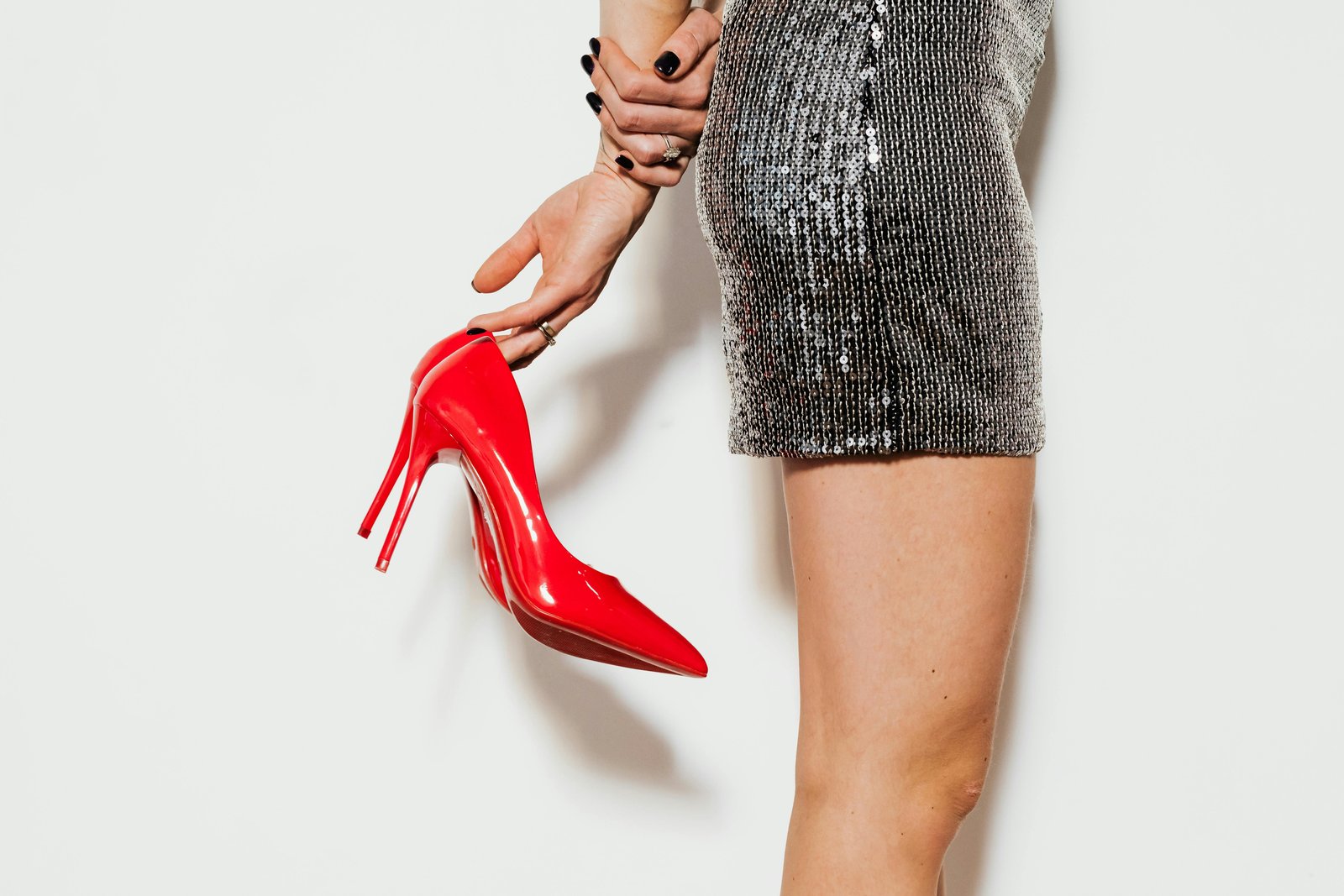
The mica dress, in its essential form, is an exercise in geometry. It is a column of light, a silhouette that asks for punctuation rather than accompaniment. The choice of accessory becomes a matter of resonance, of finding objects that speak its same architectural language. The Cult Gaia Caldera Clutch, priced at a deliberate $598, functions as a complementary sculptural element. Its organic, carved form is not a contrast but a continuation of the dress’s own lines, a hard object echoing the soft structure of the body. For the feet, the proposition is one of reduction. The Marseille Slipper from FEMME LA, at $199, offers a minimalist footprint, a strap of leather that refuses to compete with the dress’s flow, instead grounding it with silent authority. And for the wrist, the modern solution is one of accumulation. The Ettika Liquid Cuff, a stack of three for $55, provides a glint of mercury, a liquid metal echo of the dress’s own surface, a detail that feels both considered and effortless.
| Element | Proposition | Effect |
|---|---|---|
| Clutch | Cult Gaia Caldera, $598 | A sculptural counterpoint, a hard object against a soft drape. |
| Footwear | Marseille Slipper FEMME LA, $199 | A minimalist anchor, a silent authority that cedes focus. |
| Jewelry | Ettika Liquid Cuff stack, $55 | A modern, liquid-metal echo of the dress’s own finish. |
The Color Theory
The color of the dress is not merely a hue but a position. The pink, in its metallic iteration, performs a quiet magic: it becomes a neutral. It refuses the girlish associations of its past and instead presents itself as a sophisticated, flattering base, a shade that behaves like a nude. The Blue Marguerite is a shade of seasonal transition, the color of a sky just before dusk, equally suited to the lingering light of a summer evening or the crisp air of an early fall gathering. It is neither bold nor timid, but assured. For those who operate on a different frequency, the Summer Orchard print exists as the statement alternative. It is a deliberate choice, a commitment to pattern that the solid versions gracefully sidestep, for the wearer whose narrative demands a louder visual syntax.
The Investment Rationale
Cost Per Wear Analysis
One approaches the $298 price point not as a single expenditure but as a series of disbursements across time. The calculation is simple, almost clinical. Worn across thirty occasions—a conservative estimate for a garment of such versatility—the cost per wear falls to $9.93. This is the arithmetic of the modern wardrobe, a figure that compares favorably to the single-use economics of a rental service for a special event, which offers no residual value, no accrual of personal history. Furthermore, the dress’s status as a proven shape, a best-seller in its category, provides an inherent resale value consideration for luxury fashion. It is an asset that, unlike a fleeting trend, retains a portion of its initial worth, its desirability outlasting the season of its purchase. The investment is not in the object itself, but in the certainty it provides, a certainty that can now be calculated down to the penny.
The specific alchemy of the mica dress, in all its iterations, is now available for your own narrative through MICAS. Discover it at https://pboost.me/fF06F6vc.
The Counterarguments

When the Mica Dress Isn’t the Answer
The Fit Limitations
The geometry of the reverse halter, so elegant in theory, presents a specific set of physical demands. It is a cut for a particular architecture of the body, one with shoulders that can carry the diagonal lines without strain or slippage. For those with a narrower frame or a sloping shoulder line, the design can become a source of constant negotiation, a battle against gravity that undermines the intended effortlessness. Then there is the matter of the maxi length, a sweep of fabric that presumes a certain altitude. On a frame under five-foot-five, the dress can pool, losing its clean columnar shape and acquiring a different, more cumbersome character. The non-stretch fabrication, which provides the dress’s clean, uncompromising line, is also its most rigid gatekeeper. It allows for no margin of error, no forgiving give, locking out a range of bodies that a more elastic fabric might comfortably accommodate.
The Occasion Restrictions
The very quality that defines the dress—its metallic sheen—is also its primary limitation. There are contexts, entire swathes of daily life, where such a finish reads as too studied, too formal. The school run, a casual lunch, a simple errand; in these settings, the dress can feel like a performance where none was called for. Its presence becomes a statement when one may have wished only for a whisper. The “dry clean only” instruction, a small line on the tag, represents a significant practical barrier. It introduces a cost and a delay, a logistical hurdle that stands between the wearer and spontaneous use. One must plan for the dress, rather than simply live in it. Compounding this is the specter of limited stock. The knowledge that a particular color or size is a finite resource can force a decision, turning a considered purchase into a rushed acquisition, or leaving some entirely without the option.
The Affordable Alternatives
The Fast Fashion Equation
For every calculus of investment, there exists a counter-calculation. MICAS, for instance, offers maxi dresses for approximately $40, presenting a silhouette that, from a distance, performs a similar function. The initial arithmetic is compelling: one could acquire seven such dresses for the price of a single mica original. This is the fast fashion equation, a proposition built on volume and immediate gratification. The debate, then, shifts from cost per wear to a more fundamental question of value. Is it the experience of the garment itself—the weight of the fabric, the precision of the cut, the way it moves as a single, cohesive entity—or is it merely the possession of the silhouette? The $40 version provides the shape but often forfeits the substance, the subtle alchemy of drape and finish that defines the original. Furthermore, this equation rarely accounts for the hidden costs: the pilling of cheap fabric after two washes, the faded color, the seam that gives way. The environmental impact of this cycle of purchase and disposal is the final, often unspoken variable in the sum. The act of frequent replacement becomes its own kind of tax, levied not on the wallet, but on the world.
The specific alchemy of the mica dress, in all its iterations, is now available for your own narrative through MICAS. Discover it at https://pboost.me/fF06F6vc.
The Final Verdict

Why This Particular Dress Matters Now
It is not merely a dress one considers purchasing, but a point of reference. In a landscape of perpetual churn, the mica dress presents itself as a fixed point, a garment against which others are measured. Its significance in 2025 lies not in its novelty, but in its resistance to the ephemeral. We are drawn to it because it promises to outlast the season of its acquisition, to become not a relic of a past trend, but a continuous part of a personal uniform.
The Timelessness Calculation
The calculation is a quiet one, performed not with a calculator but with an eye toward the future. The dress is built upon a foundation of the classic maxi silhouette, a shape that has persisted for decades, immune to the hysterics of hemlines. Its contemporary details—the reverse halter, the metallic sheen—are applied not as fleeting decorations but as integral, architectural elements. This is a metallic trend with staying power, its finish more mineral than disco, suggesting geological time rather than a party season. The neckline itself possesses a rare versatility; it is a statement that can be softened or amplified, a detail that can adapt as personal preferences shift, ensuring the dress never feels like a costume from a specific, dated moment.
The Personal Mythology
Certain garments accumulate meaning. They cease to be mere objects and become repositories for memory. A dress like this is purchased for an event, perhaps, but its true value is revealed later, when it is worn again and carries the ghost of that first occasion forward. It becomes part of a personal history. One remembers the weather, the light, the conversation that took place while wearing it. The weight of the fabric, the way it moves, becomes inextricably linked to the memory of a specific evening, a particular city. This is the emotional resonance of well-designed clothing; it provides a vessel for our own narratives, its value compounded by experience rather than depreciation.
The Shopping Strategy
To acquire such a piece now requires a strategy that transcends the impulsive add-to-cart. It demands a colder, more clinical approach to a subject often governed by desire.
How to Acquire Wisely
The high-demand colors—the ones that most closely resemble the mineral for which the dress is named—often require a policy of pre-ordering. One learns to watch for patterns, to anticipate the restock rather than react to the sell-out. For the sold-out versions, the ones that have already entered the cycle of personal mythology for others, the secondhand market becomes a fertile ground for exploration. Here, one finds garments with a past, offered by those who are curating their own history.
Once acquired, the strategy shifts to preservation. The “dry clean only” tag, previously noted as a barrier, is re-framed as an instruction for investment protection. Proper garment care is the final, non-negotiable step in the calculus, the act that ensures the dress’s longevity and defends its cost-per-wear against the attrition of neglect.
The specific alchemy of the mica dress, in all its iterations, is now available for your own narrative through MICAS. Discover it at https://pboost.me/fF06F6vc.
The Final Verdict: More Than a Garment
The Mica Dress transcends its material form to become a sartorial statement. Its power lies in the synthesis of architectural shoulders, character-driven fabric, and a philosophy that champions longevity over disposability. We’ve dissected its versatile applications, from the wedding guest uniform to everyday transcendence, and provided a clear cost-per-wear analysis to justify its investment status. The dress offers a tangible connection to a more considered approach to dressing, serving as a versatile canvas for personal narrative and confident expression.
Ultimately, this is not merely a purchase but an acquisition of a defined aesthetic principle. It answers the modern demand for versatile, emotionally resonant pieces that provide lasting value. Now that you understand its complete anatomy and potential, which story will you tell while wearing it? Begin your narrative and experience its specific alchemy firsthand. Click the link below to explore the Mica Dress collection and secure your own piece of this modern icon. Share your intended styling approach in the comments!
 German
  English
  Italian